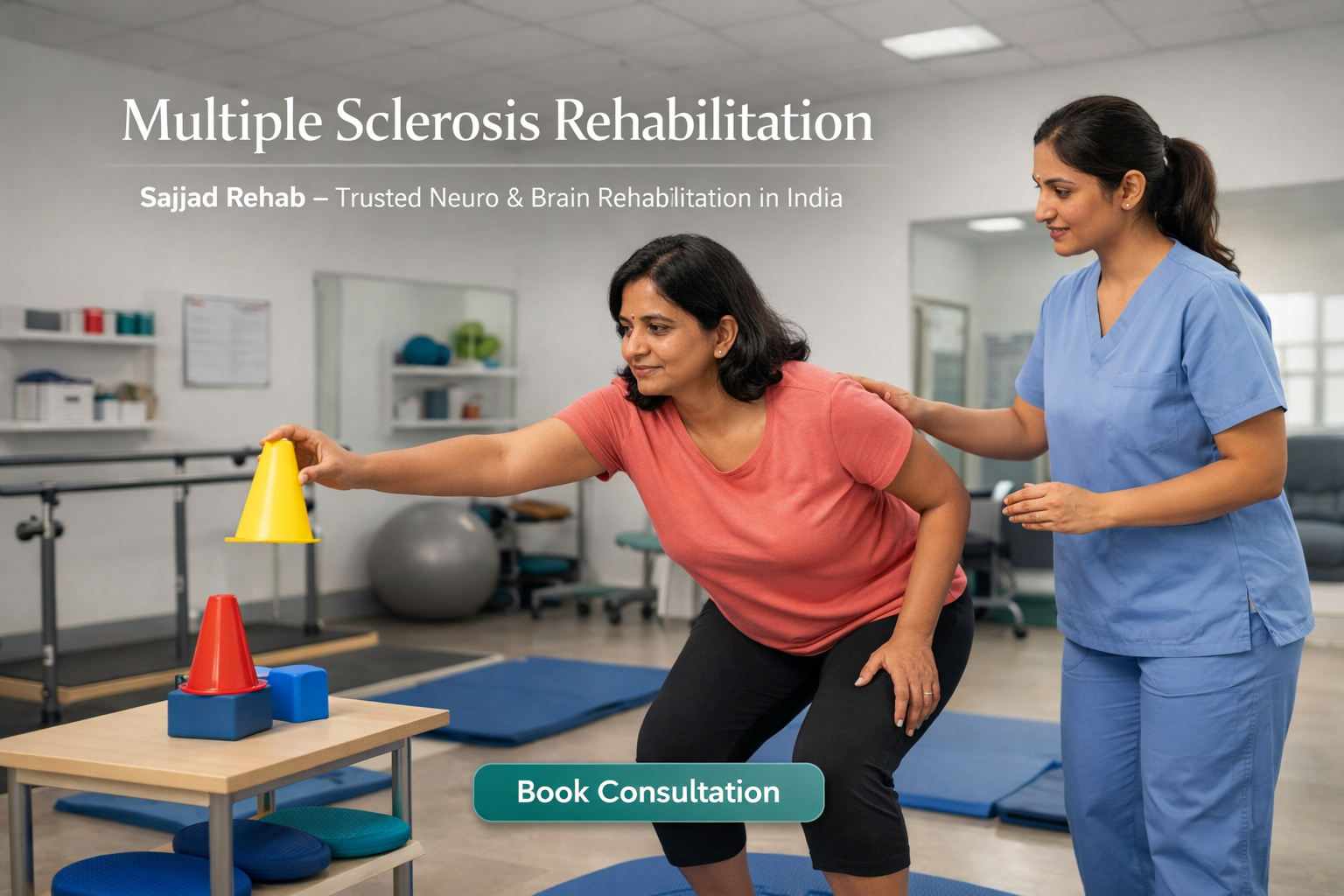
Comprehensive rehabilitation programs designed to help individuals with Multiple Sclerosis manage symptoms, improve mobility, and maintain their quality of life through specialized neuro physiotherapy.
Overwhelming tiredness that is not relieved by rest and interferes with daily activities.
Muscle stiffness, spasms, and weakness that can affect mobility and coordination.
Problems with gait, balance, and fine motor control, increasing fall risk.
Neuropathic pain, muscle spasms, and musculoskeletal pain.
Difficulties with memory, attention, and information processing.
Challenges with bladder control and bowel movements.
Multiple Sclerosis (MS) is a chronic, unpredictable disease of the central nervous system that disrupts the flow of information within the brain, and between the brain and body. It can lead to a wide range of symptoms affecting movement, sensation, and cognitive function. Multiple Sclerosis rehabilitation is crucial for managing these symptoms, improving functional abilities, and maintaining independence.
At Sajjad Rehabilitation & Therapy Centre, we provide personalized, evidence-based programs to help patients with MS navigate their condition and live fulfilling lives.
While there is no cure for MS, rehabilitation plays a vital role in managing its diverse symptoms and improving functional independence. It leverages the brain's neuroplasticity to help individuals adapt to changes and learn compensatory strategies.
Guided therapy is essential to address specific symptoms, prevent secondary complications, and empower individuals to maintain an active and engaged lifestyle. Our focus is on preserving function and enhancing overall well-being.
Starting rehabilitation early and consistently, even in the initial stages of MS, can help slow the progression of functional decline, manage symptoms more effectively, and improve long-term outcomes. It's about staying ahead of the disease's impact.
Detailed evaluation of neurological symptoms, mobility, balance, and functional limitations.
Collaborative development of realistic goals to address specific challenges.
Techniques to reduce fatigue, spasticity, and pain.
Exercises to improve walking, balance, and daily activities.
We utilize evidence-based methods specifically designed for managing Multiple Sclerosis:
Family and caregivers are integral to supporting individuals with MS. We provide guidance on:
Multiple Sclerosis is a chronic condition with varying progression. Rehabilitation aims to empower individuals to live their best possible lives by managing symptoms, adapting to changes, and maintaining functional independence.
Our goal: To help individuals with MS maintain their independence, participate in meaningful activities, and enhance their overall well-being.
Get a professional evaluation and a personalized rehabilitation plan.
Explore our full range of neuro rehabilitation programs for various neurological conditions.
Yes, rehabilitation can help people with multiple sclerosis manage symptoms, improve mobility, support balance, and maintain daily function. It does not cure MS, but it can reduce the impact of symptoms on everyday life.
MS rehabilitation may address walking problems, weakness, spasticity, poor balance, fatigue, hand function issues, and difficulty with daily tasks. The plan depends on whether symptoms are stable, relapsing, or progressing.
For many people with MS, carefully planned exercise is safe and helpful. Sessions often need to be adjusted for fatigue, heat sensitivity, weakness, and balance problems so the patient can work safely without overexertion.
Yes, fatigue management is an important part of MS rehabilitation. Patients may benefit from pacing strategies, conditioning, posture correction, mobility training, and planning activities to reduce energy drain.
Therapy frequency depends on current symptoms, relapse history, endurance, and goals. Some patients benefit from focused therapy blocks during difficult phases, followed by a home program and periodic review.
Sudden worsening should be discussed with the treating neurologist because it may represent a relapse, infection, medication issue, or another medical problem. Rehabilitation can be adjusted, but new symptoms should not be ignored.