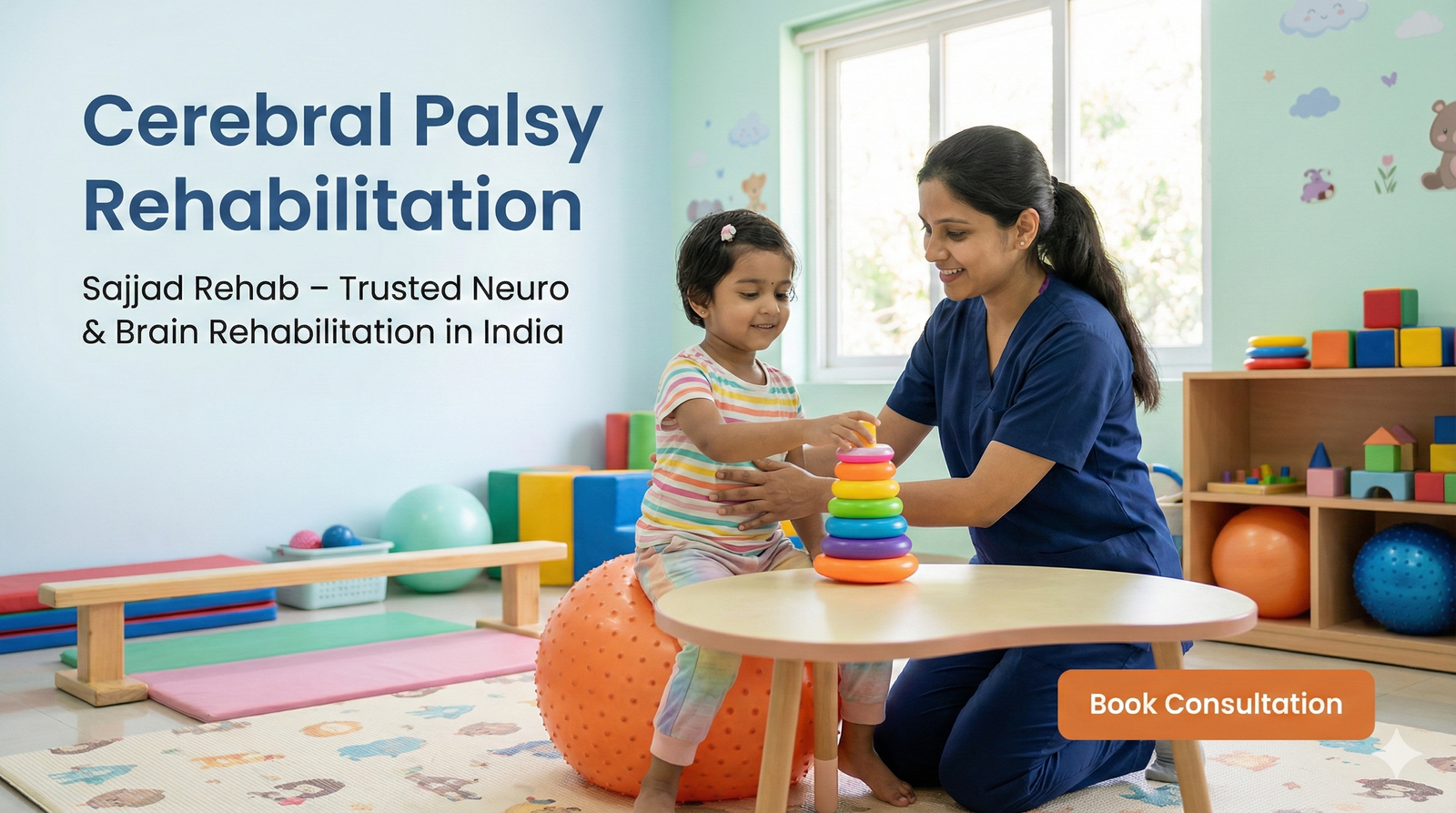
Comprehensive rehabilitation programs designed to help children with Cerebral Palsy improve motor skills, balance, and achieve greater independence. We focus on maximizing developmental potential through specialized neuro physiotherapy.
Tight muscles that can make movement difficult, painful, and lead to contractures.
Difficulty achieving developmental milestones like sitting, crawling, walking, or fine motor tasks.
Problems with maintaining balance, leading to unsteady gait and increased risk of falls.
Uncontrolled or involuntary movements that interfere with functional activities.
Challenges with articulation, swallowing, and oral motor control, often requiring speech therapy.
Risk of joint deformities, scoliosis, and pressure sores due to limited mobility.
Cerebral Palsy (CP) is a group of disorders that affect a person’s ability to move and maintain balance and posture. It is caused by abnormal brain development or damage to the developing brain that occurs before birth, during birth, or within a few years after birth. Cerebral Palsy rehabilitation is crucial for helping children develop motor skills, manage symptoms, and improve their quality of life.
At Sajjad Rehabilitation & Therapy Centre, we provide a nurturing and stimulating environment where children with CP can thrive, focusing on their unique developmental needs.
While Cerebral Palsy is a lifelong condition, the developing brain has remarkable neuroplasticity—the ability to adapt and form new connections. Rehabilitation leverages this capacity to help children learn new ways to move and function.
Guided therapy is essential because it provides targeted interventions that stimulate motor development, improve muscle control, and prevent secondary complications. Our focus is on functional improvement, enabling children to participate more fully in daily activities and reach their highest potential.
Starting rehabilitation as early as possible, ideally at the time of diagnosis, is critical for children with CP. Early intervention can significantly influence brain development, improve motor outcomes, and prevent the progression of physical limitations. It helps establish foundational skills during crucial developmental windows.
Detailed evaluation of motor skills, muscle tone, reflexes, posture, and functional abilities.
Setting realistic, age-appropriate developmental goals in collaboration with parents.
Application of specialized techniques to facilitate normal movement patterns and inhibit abnormal ones.
Engaging children in play activities to practice and generalize new motor skills.
We utilize evidence-based methods specifically designed for pediatric neurological recovery:
Parents and caregivers are integral to a child's rehabilitation journey. We provide comprehensive guidance on:
Cerebral Palsy is a non-progressive condition, meaning the brain damage does not worsen over time. However, the physical manifestations can change as the child grows. Rehabilitation aims to optimize the child's physical abilities and prevent secondary complications.
Our goal: To empower every child with CP to achieve their maximum functional independence, participate in age-appropriate activities, and lead a fulfilling life.
Get a professional evaluation and a personalized rehabilitation plan.
Explore our full range of child rehabilitation services and neuro rehabilitation programs.
If you notice delayed motor milestones (e.g., not sitting by 8 months, not walking by 18 months), unusual movement patterns, persistent stiffness, or significant challenges with balance and coordination in your child, it is advisable to seek professional assessment and rehabilitation support.
There is no cure for cerebral palsy, but early and ongoing rehabilitation can improve movement, posture, communication, and independence. The aim is to help the child reach the best possible function for daily life.
Early intervention is important because children learn movement and functional skills rapidly in the early years. Starting therapy early can support development and reduce secondary problems such as stiffness, poor positioning, and delayed motor milestones.
Goals may include better head and trunk control, improved sitting, standing, walking, hand use, self-care, feeding skills, and participation in home and school activities. Goals are based on the child's current abilities and family priorities.
Many children benefit from a multidisciplinary approach that may include physical therapy, occupational therapy, speech therapy, feeding support, and caregiver training. The combination depends on the child's movement, communication, and daily living needs.
Therapy frequency depends on age, developmental stage, muscle tone, current goals, and the child's stamina. Consistent therapy plus a simple home routine usually gives better long-term progress than occasional sessions alone.
Parents and caregivers play a major role by helping with positioning, stretching, safe handling, practice during play, and follow-through at home. Family involvement makes therapy more consistent and meaningful for the child.