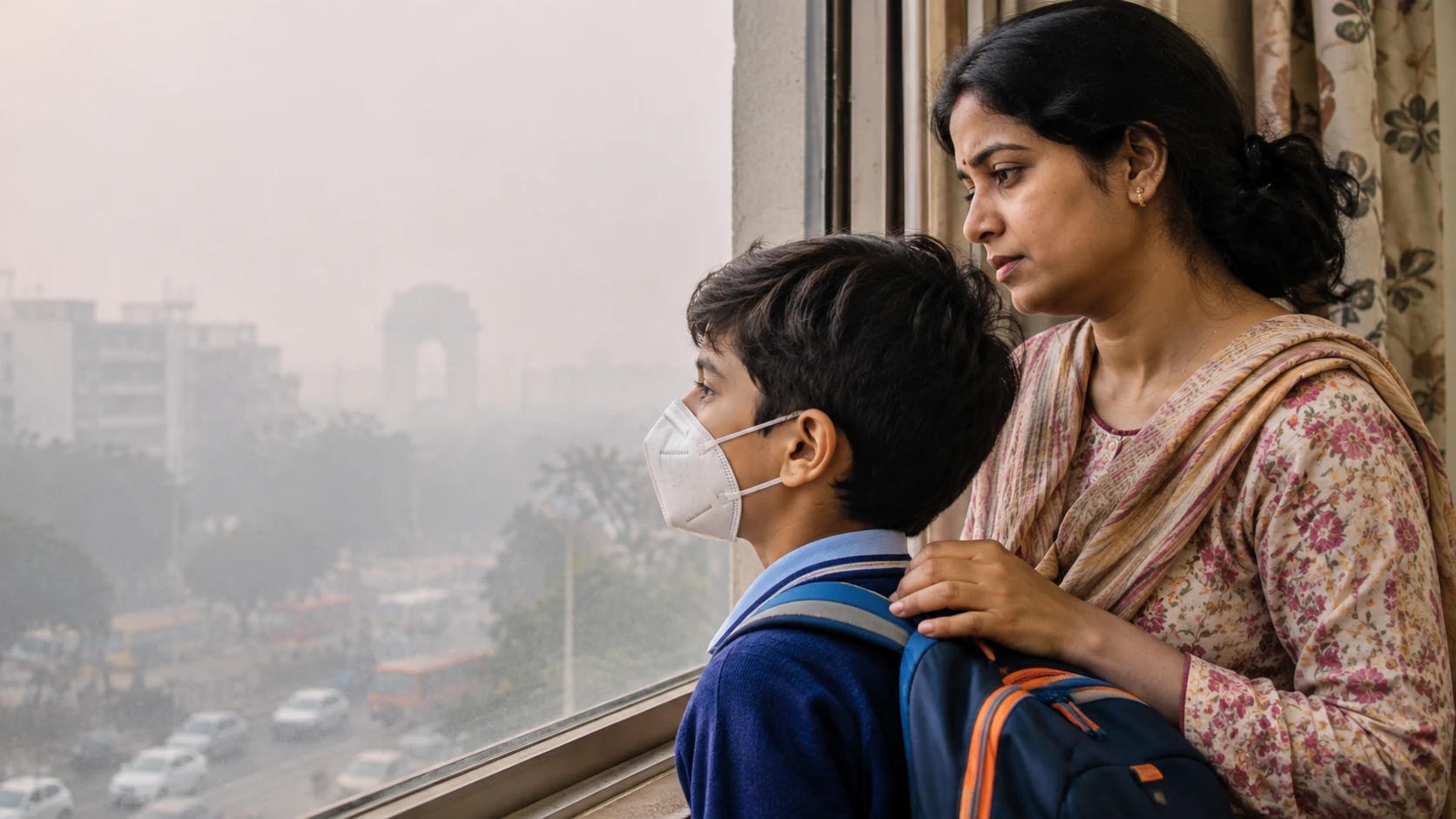
A child wakes up for school in Delhi. His mother opens the curtains, expecting the usual morning sunlight. Instead, a thick grey haze hangs over the buildings outside.
The school uniform is ready. His lunchbox is packed. But before leaving home, his mother checks something that has become increasingly important for families in the capital: the Air Quality Index.
Should he go outside? Is it safe to play? Could the polluted air make his cough worse?
These are no longer unusual questions.
As Delhi confronts another period of seasonal air pollution, families are increasingly concerned about respiratory illnesses and long-term health risks.
On November 10, 2026, former World Health Organization chief scientist Dr Soumya Swaminathan called for a coordinated national response to India's air pollution crisis, comparable in urgency to the response to COVID-19.
Her warning raises an uncomfortable question.
What happens to a generation of children who spend their early years breathing polluted air?
Delhi's Air Pollution Crisis Is Bigger Than a Winter Problem
Every winter, Delhi's polluted air becomes a national headline.
People share photographs of smog-covered roads. Schools reconsider outdoor activities. Families search for masks and air purifiers.
But the problem does not begin when the sky turns grey.
Air pollution is a year-round health concern, although weather conditions and emission patterns can make it particularly severe during certain periods.
Vehicle exhaust, industrial emissions, construction dust, waste burning and other sources contribute to the pollution mixture.
During cooler months, atmospheric conditions can restrict the dispersal of pollutants, allowing concentrations to increase.
The result is an environment in which everyday activities, such as walking to school or waiting at a bus stop, can involve exposure to harmful air.
The concern is especially serious for children, pregnant women, older adults and people with existing heart or lung conditions.
Why Delhi Air Pollution Is More Dangerous for Children
Children are not simply smaller versions of adults.
Their lungs, immune systems and other organs are still developing.
They also breathe more air relative to their body weight than adults, which can increase their exposure to airborne pollutants.
Children frequently spend time outdoors, where they may encounter pollution from traffic and other sources.
For a child with asthma, poor air quality can trigger coughing, wheezing and breathing difficulties.
Even children without a diagnosed respiratory condition can experience irritation or respiratory symptoms during polluted periods.
Long-term exposure has also been associated with impaired lung development.
This is why childhood exposure deserves particular attention.
A child may appear healthy today while still being exposed to environmental conditions that increase future health risks.
What Happens When Children Breathe PM2.5?
One of the most concerning pollutants in Delhi's air is PM2.5.
PM2.5 refers to airborne particles with diameters of 2.5 micrometres or smaller.
These particles are much smaller than the width of a human hair.
Because of their size, they can penetrate deep into the respiratory system.
Some particle components can also pass into the bloodstream and contribute to inflammation elsewhere in the body.
Repeated exposure is associated with respiratory and cardiovascular health risks.
For children, particular concerns include asthma symptoms, respiratory infections and impaired lung growth.
The health effects depend on pollution concentrations, duration of exposure, individual vulnerability and other factors.
PM2.5 cannot be reliably judged by looking at the sky. A clear-looking day does not necessarily mean the air is safe.
Delhi AQI: What Do the Numbers Actually Mean?
The Air Quality Index, commonly called AQI, helps communicate outdoor air pollution levels.
India's AQI system groups air quality into six categories.
| AQI Range | Air Quality Category |
|---|---|
| 0–50 | Good |
| 51–100 | Satisfactory |
| 101–200 | Moderate |
| 201–300 | Poor |
| 301–400 | Very Poor |
| 401–500 | Severe |
These categories describe increasing pollution levels and associated health concerns.
People with respiratory conditions, children and older adults may be particularly vulnerable as pollution increases.
However, AQI is not a diagnosis or an individual prediction of illness.
Parents should consider the current AQI alongside their child's health, symptoms and planned activities.
For reliable local information, consult the Central Pollution Control Board.
The Health Damage May Begin Before Birth
Air pollution is not only a concern for children who are already attending school.
Exposure during pregnancy is also important.
Research has found associations between maternal exposure to air pollution and certain adverse pregnancy outcomes, including preterm birth and low birth weight.
These findings do not mean that every pregnant woman exposed to polluted air will experience complications.
Pregnancy outcomes depend on numerous medical, genetic, social and environmental factors.
Nevertheless, reducing avoidable exposure is an important preventive step.
Pregnant women living near busy roads or heavily polluted areas may find it difficult to avoid outdoor pollution completely.
Indoor exposure can also occur through cooking smoke, tobacco smoke and pollution entering from outside.
Regular antenatal care, appropriate management of existing health conditions and practical exposure-reduction measures remain important.
Can Delhi's Polluted Air Affect Children's Brain Development?
Most people associate air pollution with coughing and breathing problems.
But scientists are also studying its possible effects on the developing brain.
Research has investigated associations between exposure to airborne pollutants and outcomes involving attention, cognition, learning and neurodevelopment.
Some observational studies have reported associations, but the findings must be interpreted carefully.
Child development is influenced by many factors, including genetics, pregnancy health, nutrition, education and the home environment.
Air pollution exposure alone cannot explain why an individual child has autism, ADHD or a speech delay.
Parents should avoid assuming that a developmental condition was caused by pollution.
However, the broader research supports efforts to reduce harmful environmental exposure during pregnancy and childhood.
What If Parents Notice Developmental Difficulties?
Some parents become concerned when their child is not speaking at the expected age, has difficulty communicating or shows differences in social interaction.
These concerns deserve appropriate assessment, regardless of whether the family lives in a polluted city.
Parents can learn more about early communication and developmental differences in the article Speech Delay or Autism? How to Tell.
If a child is already receiving communication support but progress seems limited, the guide Speech Therapy Not Working? What Parents Should Know discusses questions families can raise with their therapy team.
These resources address developmental concerns. Speech therapy and autism interventions are not treatments for pollution exposure.
Seven Warning Signs Parents Should Not Ignore
During periods of heavy air pollution, parents should pay attention to changes in their child's health.
Possible warning signs include:
- Persistent coughing: A cough that continues, worsens or interferes with sleep deserves medical attention.
- Wheezing: A whistling sound during breathing may indicate narrowing of the airways.
- Shortness of breath: Difficulty breathing during normal activities should not be ignored.
- Chest tightness: Children may describe discomfort or pressure in the chest.
- Eye and throat irritation: Polluted air can cause irritation, although other causes are possible.
- Reduced exercise tolerance: A child who suddenly struggles with usual physical activities may need evaluation.
- Worsening asthma symptoms: More frequent symptoms or increased need for prescribed reliever medication can indicate poor asthma control.
These symptoms are not specific to pollution. Respiratory infections, allergies and other medical conditions may produce similar problems.
Seek medical advice when symptoms persist, worsen or interfere with daily activities.
Emergency warning: Severe breathing difficulty, blue or grey lips, marked chest retractions, confusion or unusual drowsiness require urgent emergency medical care.
Is Staying Indoors Enough to Protect Children?
Many parents believe that closing windows and keeping children indoors will completely protect them from Delhi's pollution.
Unfortunately, indoor air is not automatically clean.
Outdoor pollutants can enter buildings through gaps, doors, windows and ventilation systems.
Indoor sources may also contribute to poor air quality.
These include tobacco smoke, cooking emissions, burning incense, mosquito coils and other combustion sources.
During severe pollution episodes, limiting unnecessary outdoor exposure may help.
However, families should also reduce indoor smoke and consider appropriate ventilation and filtration.
A well-maintained air cleaner with effective particle filtration may reduce indoor particulate pollution.
Air purifiers do not eliminate every pollutant and should not be treated as a substitute for cleaner outdoor air.
Should Children Wear N95 Masks During Delhi Smog?
A properly fitted N95 or comparable particulate respirator can reduce inhalation of fine particles.
However, the level of protection depends on fit, correct use and the quality of the respirator.
An adult-sized mask may not fit a child properly.
Very young children may be unable to use tight-fitting respirators safely or effectively.
Parents should select age-appropriate protective equipment and seek professional guidance when needed.
A loose surgical or cloth mask should not be assumed to provide the same protection against PM2.5 as a properly fitted particulate respirator.
Masks are one possible exposure-reduction measure, not a complete solution.
What Parents Can Do When Delhi's Air Quality Becomes Poor
Families cannot control traffic emissions or industrial pollution by themselves.
But they can take practical steps to reduce unnecessary exposure.
1. Check Air Quality Before Leaving Home
Review reliable local AQI information before planning outdoor exercise, school activities or long periods outside.
2. Modify Outdoor Activities
During highly polluted periods, consider moving strenuous exercise indoors or rescheduling it.
Physical activity remains important for children's health, so safer alternatives are preferable to abandoning exercise altogether.
3. Reduce Indoor Smoke
Avoid smoking indoors, burning waste or using unnecessary smoke-producing products.
4. Protect Children With Asthma
Follow the child's prescribed asthma action plan and keep necessary medication available.
Do not discontinue prescribed treatment without medical advice.
5. Consider Cleaner Travel Routes
Where practical, avoid prolonged exposure near congested roads and idling vehicles.
6. Improve Indoor Air Quality
Reduce indoor emission sources and consider suitable filtration when available.
7. Seek Medical Care When Symptoms Worsen
Persistent coughing, recurrent wheezing and unusual breathing difficulties should be evaluated by a qualified healthcare professional.
Why Delhi's Pollution Crisis Affects Poorer Families Differently
Advice about air pollution often assumes that every family can stay indoors, purchase an air purifier or avoid travelling during dangerous conditions.
For many people, these options are unrealistic.
A construction worker cannot easily avoid outdoor dust.
A street vendor may depend on working beside a busy road.
A delivery worker may spend hours in traffic.
A child living in a small, poorly ventilated home may continue breathing polluted air even when schools close.
These circumstances reveal an important public health inequality.
Families with fewer resources may experience substantial exposure while having fewer ways to reduce it.
Cleaner public transport, affordable clean cooking fuels, better housing and stronger emission controls can provide broader protection.
Air pollution prevention should not become a privilege available only to households that can afford expensive equipment.
Why Experts Want a COVID-Like Response
In her November 10 interview with India Today, Dr Soumya Swaminathan argued that India's response to air pollution needs stronger national coordination and long-term planning.
The comparison with COVID-19 concerns the urgency, leadership and organisation of the response.
Air pollution is not an infectious disease.
It does not spread from person to person like a virus.
But reducing its health burden requires cooperation across multiple sectors.
Transport policies, industrial emission controls, waste management, clean household energy and public health monitoring all matter.
Emergency measures during severe pollution episodes can help reduce exposure.
However, temporary restrictions cannot replace sustained action to reduce pollution at its source.
A stronger public health response could also connect environmental measurements with health information, helping policymakers better understand the effects on communities.
This approach could support more informed decisions about prevention and resource allocation.
Delhi Is Not the Only City at Risk
Although Delhi receives national attention, air pollution affects many Indian cities.
Communities across the Indo-Gangetic Plain face pollution from transport, industry, construction, agriculture and household fuel combustion.
Patna and other cities in Bihar also need sustained attention to air quality.
Pollution concentrations vary by location, season and weather conditions.
Families should rely on local monitoring rather than assuming that air quality in one city represents conditions everywhere.
The lesson from Delhi is relevant across India: protecting children's health requires both household precautions and public policies that reduce pollution.
Why Child Health Awareness Matters Beyond Air Pollution
Air pollution is one environmental concern, but parents also need reliable information about childhood health and development.
Children may experience respiratory illnesses, communication difficulties, learning challenges or other health concerns for many different reasons.
Understanding these concerns early can help families seek appropriate professional guidance.
For parents looking for information about developmental conditions, the article How Is Autism Spectrum Disorder Treated? explains commonly used support approaches.
Families seeking information about rehabilitation and child-development support can also explore physiotherapy and rehabilitation services.
These services address their respective clinical needs and should not be presented as treatments for air pollution-related illness.
The Future Cost of Breathing Polluted Air
A child growing up in Delhi today may never remember the first time they experienced polluted air.
It may simply become part of everyday life.
Morning haze. Reduced outdoor play. A cough that returns during winter. Parents checking the AQI before school.
But familiar conditions are not necessarily harmless.
Scientific evidence already links air pollution exposure to significant health risks, particularly involving the lungs and cardiovascular system.
Researchers continue to investigate its broader long-term effects.
The challenge is to prevent avoidable exposure before health consequences become apparent.
Children cannot choose the air they breathe.
They depend on adults, communities and governments to protect the environments in which they grow.
Clean air should not be a luxury. For every child, it should be a basic condition of a healthy life.
You May Also Know
Why Is Delhi Air Pollution Particularly Concerning for Children?
Children's lungs and other organs are still developing. They also breathe more air relative to their body weight than adults, increasing their vulnerability to harmful pollutants.
What Is PM2.5 in Delhi Air Pollution?
PM2.5 consists of fine airborne particles measuring 2.5 micrometres or smaller. These particles can penetrate deep into the lungs and contribute to adverse health effects.
What AQI Level Is Dangerous in Delhi?
Under India's AQI system, readings of 201–300 are classified as Poor, 301–400 as Very Poor and 401–500 as Severe. Health risks vary by exposure and individual vulnerability.
Can Delhi Pollution Cause Asthma in Children?
Air pollution can worsen existing asthma and is associated with an increased risk of developing asthma. It is not the only factor involved in the condition.
Can Air Pollution Affect Unborn Babies?
Research has associated exposure during pregnancy with increased risks of certain adverse outcomes, including low birth weight and preterm birth.
Is an Air Purifier Necessary for Every Delhi Household?
An appropriate air purifier may help reduce indoor particle concentrations, but it is not mandatory for every household or a complete solution. Reducing indoor smoke and outdoor emissions is also important.
Can Air Pollution Cause Autism or ADHD?
Some studies have examined associations between pollution exposure and neurodevelopmental outcomes. These findings do not establish that pollution alone causes autism or ADHD in an individual child.
What Should Parents Do if Their Child Coughs During Smog?
Reduce unnecessary exposure and monitor symptoms. Seek medical advice for persistent coughing, wheezing or breathing problems. Severe respiratory distress requires emergency care.