
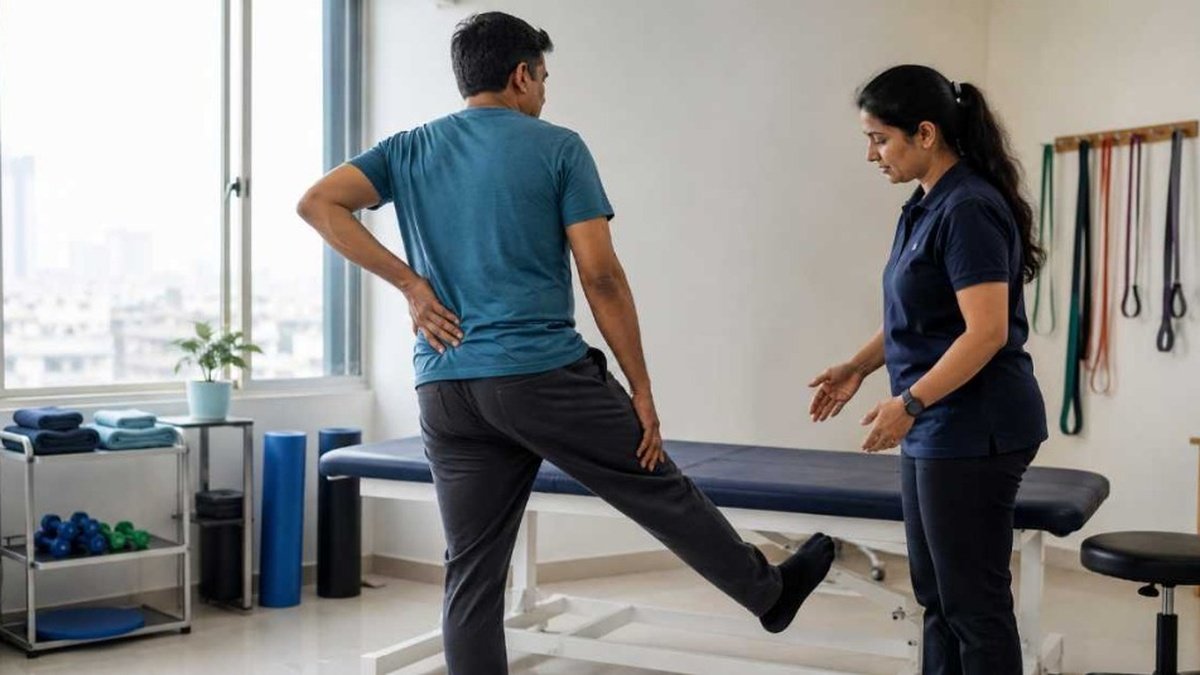
Sciatica treatment in Patna usually starts with a careful assessment, advice to keep moving, and an individualized physiotherapy programme rather than immediate scans, prolonged bed rest or a one-size-fits-all machine treatment. Sciatica commonly causes sharp, burning or electric pain that travels from the lower back or buttock into one leg, sometimes with tingling, numbness or weakness. Many cases improve within weeks to a few months, but worsening weakness, bladder or bowel changes, numbness around the groin or symptoms in both legs need urgent medical attention. This guide explains what evidence-based physiotherapy can do, what to expect at an appointment in Patna, which treatments have stronger guideline support, when MRI or specialist review may be needed, and how to choose care without falling for unrealistic promises.
Table of Contents
- What sciatica is and how it feels
- Common causes of sciatic nerve pain
- When sciatica needs urgent medical care
- How sciatica is assessed
- How physiotherapy for sciatica works
- Exercises and activity: what is usually included
- Physiotherapy vs medicines, injections and surgery
- When MRI or other tests may be useful
- Recovery timeline and signs of progress
- Sciatica treatment cost in Patna
- How to choose a physiotherapist in Patna
- Common mistakes that can delay recovery
- Practical next steps
- Frequently asked questions
What Is Sciatica?
Sciatica is a pattern of nerve-related symptoms, not simply another name for lower back pain. It usually involves pain that travels from the lower back or buttock down one leg. The pain may reach the thigh, calf, foot or toes. Tingling, pins and needles, numbness or weakness can occur in the same area. Coughing, sneezing, bending or prolonged sitting may aggravate symptoms in some people.
The sciatic nerve is formed from nerve roots in the lower spine and runs through the buttock into the leg. In many cases, the problem begins at a lumbar nerve root rather than from pressure on the sciatic nerve farther down the leg. This distinction matters because hip pain, muscle pain and other nerve problems can mimic sciatica. A good assessment therefore looks at the symptom pattern and neurological function instead of assuming that every pain from the back to the leg is the same condition.
Sciatica versus ordinary back pain
| Feature | Sciatica | Non-specific lower back pain |
|---|---|---|
| Main pain area | Often buttock and one leg, with or without back pain | Mainly the lower back |
| Nerve symptoms | Tingling, numbness or weakness may occur | Usually absent |
| Pain quality | May feel sharp, burning, shooting or electric | Often aching, stiff or sore |
| Assessment focus | Nerve function plus spine and movement examination | Movement, function, loading and other causes of back pain |
What Causes Sciatic Nerve Pain?
Common causes include a herniated or slipped disc, narrowing around the spinal nerves called spinal stenosis, spondylolisthesis and back injury. Age-related changes in discs and joints can also contribute. Less commonly, serious conditions such as infection, cancer or major trauma can produce back and leg symptoms and require medical investigation.
Not every disc bulge seen on a scan is the reason for pain. Imaging findings need to match the history, physical examination and nerve findings. This is one reason routine MRI is not recommended for every new episode of sciatica.
When Sciatica Needs Urgent Medical Care
Most sciatica is not an emergency, but some symptoms can indicate severe compression of spinal nerves. Seek emergency medical care if you develop any of the following:
- New difficulty starting urination, inability to pass urine or loss of bladder control.
- New loss of bowel control or inability to sense the need to pass stool.
- Numbness around the genitals, anus or saddle area.
- Severe or progressively worsening weakness or numbness in both legs.
- Serious sciatica on both sides, especially with new neurological changes.
Prompt medical review is also important if pain follows significant trauma, you feel systemically unwell, or your clinician suspects infection, cancer or another specific spinal disorder. Do not rely on home exercise or massage when red flags are present.
How Is Sciatica Diagnosed?
For many people, sciatica can be assessed clinically without an immediate MRI. A doctor or physiotherapist will normally ask where the pain starts, where it travels, what triggers it, how long it has been present and whether there is numbness or weakness. They should also ask about bladder and bowel function and other red flags.
A physiotherapy assessment may include
- Walking, sitting, spinal and hip movement.
- Leg strength, sensation and reflexes when appropriate.
- Nerve provocation tests such as straight-leg raise or slump when suitable.
- Movements that worsen, ease or centralize symptoms.
- Work, lifting, sleep and activity demands.
The aim is to identify neurological deficits, tolerated movement and a safe starting level for rehabilitation, not merely to label a disc level.
How Physiotherapy for Sciatica in Patna Can Help
Evidence-based physiotherapy is active and individualized. It aims to reduce disability, restore confidence in movement and rebuild capacity for daily life. Exercise is central; massage or manipulation should not be presented as a stand-alone cure.
1. Education and activity guidance
A physiotherapist can explain the expected course, identify tolerable positions and guide a gradual return to activity. Prolonged bed rest is discouraged; during a flare, brief walks or frequent position changes may be a reasonable starting point.
2. Individualized exercise
There is no universal exercise list. A programme may use trunk or hip strengthening, graded walking, mobility work or repeated movements chosen according to symptom response. Technique and response matter more than copying random online stretches.
3. Neural mobilization when appropriate
Clinical practice guidance for physical therapists allows neural mobilization to be used with other treatments for short-term improvement in pain and disability in some people with low back pain and leg pain. These movements should be dosed carefully; aggressive stretching of an irritable nerve can make symptoms worse.
4. Manual therapy as an add-on
NICE recommends considering manual therapy only as part of a package that includes exercise, with or without a psychological approach.
5. Return to work and normal activity
Rehabilitation should connect exercises to real goals such as sitting for work, walking, stairs, lifting or sport. Return to normal activity is encouraged rather than waiting for every trace of pain to disappear.
What should not be the whole treatment plan?
Be cautious if care consists mainly of passive machines without reassessment or progressive exercise. NICE does not recommend routine traction, TENS, interferential therapy or therapeutic ultrasound for low back pain with or without sciatica. Your plan should therefore not depend on these modalities.
Sciatica Exercises: What Is Usually Safe?
The safest exercise is one matched to your current neurological status and symptom response. A person with mild leg pain and normal strength may need a different programme from someone with foot weakness or severe pain below the knee.
| Exercise category | Why it may be used | Important caution |
|---|---|---|
| Short, frequent walking | Maintains activity and gradually rebuilds tolerance | Start below the level that causes a major flare |
| Directional or repeated movement | May reduce or centralize symptoms in selected patients | Direction must be based on response, not a generic rule |
| Trunk strengthening | Improves capacity for daily loading and movement | Progress gradually; avoid bracing through severe radiating pain |
| Hip and leg strengthening | Supports walking, stairs and lifting | Modify if it clearly increases nerve symptoms |
| Neural mobilization | May help pain and disability in some people when combined with other care | Use gentle sliders or therapist-guided dosage; avoid forceful nerve stretching |
A simple symptom rule
Mild, temporary discomfort during rehabilitation is not always a sign of harm. However, stop the exercise and get reassessed if it produces new or progressively worsening weakness, rapidly increasing numbness, severe persistent leg pain, or any bladder, bowel or saddle-area symptoms. If an exercise repeatedly makes pain spread farther down the leg and the change does not settle, your programme may need modification.
Physiotherapy vs Medicines, Injections and Surgery
| Option | Typical role | Key points |
|---|---|---|
| Physiotherapy and self-management | Common conservative first-line approach for uncomplicated sciatica | Focuses on activity, exercise, function, education and graded recovery |
| Medicines | May be considered by a qualified prescriber for symptom control | Benefits and risks vary. NICE advises against gabapentinoids, other antiepileptics, oral corticosteroids and benzodiazepines for sciatica and advises against opioids for chronic sciatica |
| Epidural injection | Selected cases of acute and severe sciatica | NICE says local anaesthetic plus steroid epidural injection may be considered; this requires specialist assessment |
| Spinal decompression surgery | Persistent disabling sciatica in selected patients | May be considered when non-surgical treatment has not improved pain or function and imaging findings are consistent with symptoms |
Medication decisions should be made with a doctor or other appropriately qualified prescriber. Do not start, stop or change prescription medicines based only on an online article, especially medicines associated with withdrawal or dependence.
Do You Need an MRI for Sciatica?
Usually not at the beginning of an uncomplicated episode. NICE advises against routine imaging in a non-specialist setting and recommends specialist imaging only when the result is likely to change management. MRI becomes more relevant when serious pathology is suspected, neurological deficits are significant or progressive, or a specialist is planning an injection or surgery.
How Long Does Sciatica Take to Improve?
The NHS notes that sciatica often improves in a few weeks to a few months, although some cases last longer and recurrence is possible. The useful question is not only how many days you have had pain, but whether the overall trend is improving.
Signs you may be progressing
- Leg pain is less intense or does not travel as far down the leg.
- You can walk, sit or sleep for longer before symptoms increase.
- Numbness is reducing rather than spreading.
- Strength and confidence with daily tasks are improving.
- You need fewer activity modifications to get through the day.
When to reassess the plan
Arrange review if symptoms are getting worse, if weakness is increasing, if pain is still preventing normal activities after a few weeks of self-management, or if progress stalls despite a well-followed rehabilitation plan. There is no evidence-based promise that everyone needs a fixed number such as 7, 10 or 15 sessions. Visit frequency should change according to severity, goals, neurological findings and your ability to exercise independently.
Sciatica Treatment Cost in Patna: What to Ask Before You Pay
There is no dependable single citywide price for sciatica physiotherapy in Patna. Provider fees vary, and hospital “sciatica treatment” estimates may combine consultations, scans, medicines, injections, physiotherapy and surgery, so broad package figures are not a reliable per-session physiotherapy price.
Before starting treatment, ask for a clear breakdown:
- Initial assessment or consultation fee.
- Price per clinic session and session duration.
- Home-visit charge, if you need physiotherapy at home.
- Package price, number of sessions and expiry date, if a package is offered.
- Whether reassessment is included.
- Whether machines, taping or consumables cost extra.
- Refund or rescheduling policy for prepaid sessions.
A higher price does not automatically mean better care, and the cheapest package is not automatically good value. Look for a proper assessment, measurable goals, home-exercise guidance, progress reviews and a clear reason for each treatment used.
How to Choose a Physiotherapist for Sciatica in Patna
Local searches often focus on “best sciatica doctor in Patna” or “physiotherapist near me,” but proximity and ratings are only part of the decision. For sciatica, the clinician should be comfortable screening neurological symptoms and knowing when medical referral is needed.
Use this checklist
- Assessment first: The clinician asks about leg symptoms, numbness, weakness and red flags before starting treatment.
- Clear explanation: You are told what the working diagnosis is and what remains uncertain.
- Active plan: Exercise, activity progression and self-management are central, not optional extras.
- No guaranteed cure: Be wary of promises to “permanently cure” sciatica in a fixed number of sessions.
- Progress measures: Walking, sitting, strength, sleep or work tolerance are tracked, not only a daily pain score.
- Referral pathway: The physiotherapist recommends doctor or spine-specialist review if red flags, major weakness or poor progress appear.
- Transparent charges: Fees and package terms are explained before payment.
Common Sciatica Treatment Mistakes
Waiting in bed until all pain disappears
Extended inactivity can reduce strength and confidence. Guidelines encourage continuing normal activities as much as possible, with temporary modification when symptoms are highly irritable.
Doing every sciatica stretch found online
Sciatica has different causes and movement responses. A hamstring stretch, back bend or knee-to-chest movement can help one person and aggravate another. Use symptom response and professional assessment to choose exercises.
Assuming an MRI finding is the whole diagnosis
A scan needs clinical context. Treatment decisions should connect imaging with the pattern of pain, neurological findings and function.
Depending only on passive machines
Passive care may feel soothing, but it should not replace an active recovery plan. If weeks pass without exercise progression, functional goals or reassessment, ask how the treatment is expected to improve long-term capacity.
Ignoring progressive weakness
Pain can fluctuate during recovery, but worsening muscle weakness deserves prompt medical review. New foot drop, rapidly declining leg strength or serious bilateral symptoms should not be managed by simply increasing exercise intensity.
What to Do Next if You Have Sciatica in Patna
- Screen for emergency symptoms. If you have bladder or bowel changes, saddle numbness or severe worsening neurological symptoms in both legs, seek emergency medical care.
- Keep gently active if it is safe. Avoid spending long periods in bed or one position. Short walks and frequent position changes are often more useful than complete rest.
- Arrange an assessment if pain is severe, worsening or limiting normal life. A physiotherapist or doctor can check neurological function and decide whether conservative care is appropriate.
- Ask for an exercise-led plan. Your programme should match your symptom response and functional goals and should be adjusted as you improve.
- Escalate when needed. If non-surgical care is not improving pain or function, or if neurological signs are concerning, ask whether medical or spine-specialist review is appropriate.
If you are looking specifically for sciatica treatment in Patna, use the checklist above when comparing clinics, including Sajjad Rehab or any other local provider. The most useful first appointment is one that identifies safety issues, explains the likely pain mechanism, sets realistic goals and gives you a clear plan for the next stage of recovery rather than promising instant nerve pain relief.
Frequently Asked Questions About Sciatica Treatment in Patna
Can physiotherapy cure sciatica completely?
Physiotherapy can help many people reduce pain, restore movement and return to normal activity, but no treatment can promise a cure for every cause of sciatica. Recovery depends on the underlying problem, symptom severity, neurological findings and how the condition changes over time.
How long does sciatica usually take to improve?
Many cases improve over a few weeks to a few months, although some last longer or recur. Seek medical review sooner if symptoms are worsening, weakness is increasing or pain is stopping normal daily activity.
Do I need an MRI before starting physiotherapy for sciatica?
Usually not. Guidelines advise against routine imaging in a non-specialist setting for uncomplicated low back pain with or without sciatica. Imaging is more useful when a specialist believes the result is likely to change treatment or when serious pathology is suspected.
Which exercises are best for sciatica pain?
There is no single best exercise for everyone. A physiotherapist may use graded walking, trunk or hip strengthening, movement in a preferred direction and sometimes neural mobilization, depending on what eases or aggravates your symptoms. Stop and seek advice if an exercise causes marked or progressive weakness, numbness or severe worsening.
Is bed rest good for sciatica?
Prolonged bed rest is generally discouraged. Staying as active as you can tolerate and returning gradually to normal activities is commonly recommended. Short periods of relative rest may be reasonable during a severe flare, but long periods of sitting or lying down can slow recovery.
Is traction recommended for sciatica?
NICE guidance does not recommend traction for low back pain with or without sciatica. Treatment is generally better centered on education, activity and individualized exercise, with manual therapy considered only as part of an exercise-based package.
When is sciatica an emergency?
Seek emergency medical care for new bladder or bowel control problems, numbness around the genitals or anus, severe or worsening weakness or numbness in both legs, or sciatica affecting both sides with serious neurological symptoms. These can indicate a major spinal nerve problem.
Can sciatica be treated without surgery?
Yes. Many people improve with conservative care such as staying active, physiotherapy and appropriate medical pain management. In selected cases with acute severe sciatica, a specialist may consider an epidural injection. Surgery may be considered when non-surgical care has not improved pain or function and imaging findings match the symptoms.
How much does sciatica physiotherapy cost in Patna?
There is no reliable citywide standard fee. Costs vary by assessment, clinic versus home visit, session length, therapist, number of visits and whether specialist tests or procedures are needed. Ask for the evaluation fee, per-session or package price, what is included and whether follow-up reassessment is charged separately.
Conclusion
Sciatica can be extremely painful, but severe pain does not automatically mean that surgery or an immediate MRI is required. For uncomplicated cases, evidence-based care emphasizes education, staying active and individualized exercise, with manual therapy used only as part of a broader rehabilitation plan. In Patna, compare providers by the quality of assessment, neurological screening, exercise progression, referral judgment and fee transparency rather than by claims of a quick cure. If symptoms are worsening, weakness is increasing or any bladder, bowel or saddle-area warning sign appears, seek medical care promptly.